Gold Exchange and Trends, How the Market Price Is Formed and Tracked
Interest in the gold market and the topic of the gold exchange, as well as long-term gold trends, has been growing steadily in recent years, especially in conditions of inflationary pressure, geopolitical instability, and dynamic changes in monetary policy. More and more investors are looking not just for the current price, but for a deeper understanding of the mechanisms that determine the value of gold.
To navigate this environment properly, it is important to view gold not only as an investment asset, but also as a reflection of global economic processes. In this article, we will look at how the gold exchange market works, how to interpret a gold chart, and which factors shape the leading gold trends.
Gold Exchange, How Is the Spot Price Determined?
At the core of every discussion about the gold exchange is the concept of the spot price, XAU/USD, the reference value at which gold is traded for immediate delivery on international markets. This price is formed dynamically based on global supply and demand, market liquidity, and macroeconomic expectations.
A key benchmark is the LBMA Gold Price, which is determined twice daily through an auction mechanism involving leading financial institutions. This reference value is used by banks, dealers, and exchanges around the world.
Converting the spot price into the real price for the end customer includes several consecutive components:
- international price in USD, per troy ounce
- currency conversion into BGN
- conversion into grams, ÷ 31.1034
- adding a premium and trading spread
This process explains why the final price of investment gold may differ from the exchange quotation.
Gold Chart, How to Read the Chart?
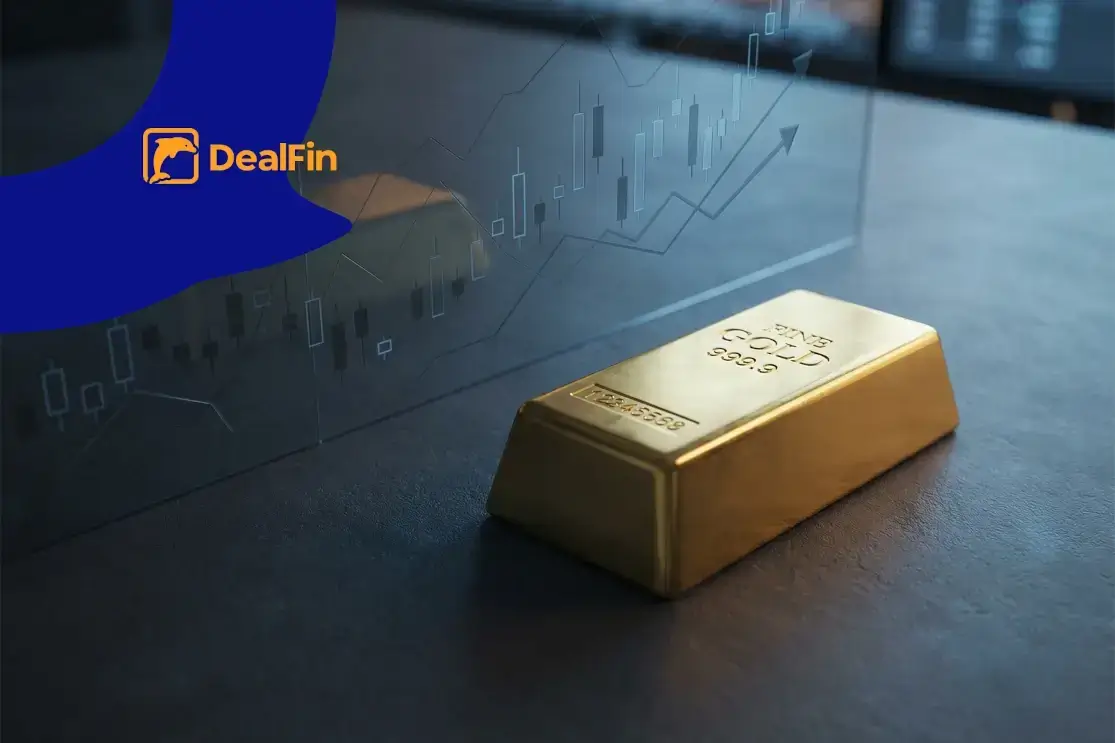
Reading a gold chart is a basic tool for analyzing market dynamics. Charts visualize price movement over time and allow you to identify patterns that are not visible from a single value.
The main time horizons include:
- daily chart, for short-term fluctuations and volatility
- monthly chart, for identifying medium-term trends
- yearly chart, for strategic investment analysis
Key elements when interpreting the chart:
Trend
A consistent increase in price signals an upward market, while a decline indicates a correction or downward cycle.
Support and resistance levels
These are psychological and technical boundaries where the price has historically changed direction.
Real-time gold chart analysis, available on dealfin.bg, allows for more accurate identification of market entry or exit points.
Gold Trends, Which Factors Move the Price?
The formation of stable gold trends is the result of interaction between several key macroeconomic and market factors:
Monetary policy and interest rates
Decisions by the U.S. Federal Reserve have a direct impact on the price of gold. Rising interest rates increase the return on alternative assets, which usually puts pressure on gold.
Central bank behavior
Central banks are among the largest market participants. Increasing gold reserves is a signal of long-term confidence and supports the price.
Geopolitical risk
In times of crisis, military conflict, or instability, gold functions as a safe haven asset, which leads to higher demand.
Currency dynamics, USD
There is an inverse correlation between the dollar and gold. A weakening USD usually leads to an increase in the price of gold.
Inflation and real interest rates
During periods of high inflation and low real interest rates, gold becomes established as a tool for preserving value.
Understanding these factors is key to forecasting future gold trends.
Spread, the Difference Between the “Buy” and “Sell” Price
The spread is a fundamental element of every gold transaction. It is the difference between the price at which the dealer sells and the price at which the dealer buys back.
Practical meaning
- high spread → higher initial loss on the investment
- low spread → more efficient and liquid position
How to evaluate the spread?
- analyze publicly announced prices
- compare different market participants
- check buyback conditions
With investment gold, the spread is often more important than the price itself, because it determines the real return. In practice, this means that even with a lower purchase price, a high spread can lead to a loss during a later sale. That is why it is important to choose dealers with transparent policies and clearly announced “buy/sell” values.
For example: if you buy gold at 130 BGN/g, but the dealer buys it back at 115 BGN/g, your real cost is significantly higher. Conversely, with a lower spread, the difference between buying and selling is minimal, which increases the liquidity of the investment.
Follow the gold exchange and trends in real time on dealfin.bg. Buy gold bars at a transparent market price with the current spread.
FAQ
The term gold exchange refers to the global system of markets and participants where the price of gold is determined in real time. It includes banks, institutions, and trading platforms that form the spot price based on supply and demand.
The most effective way to follow gold trends in real time is through specialized platforms with current data and charts. Tracking market indicators, news, and economic events is also key to understanding the dynamics.
Focus on the trend, key levels, and time period. The combination of technical analysis and macroeconomic context gives the most accurate view of the market.
The most significant factors are interest rates, inflation, the USD exchange rate, geopolitical events, and the actions of central banks.